

BN Book Review: Seagulls And Seashells by Oluwatobi Aluko | Review by Roseline Mgbodichinma
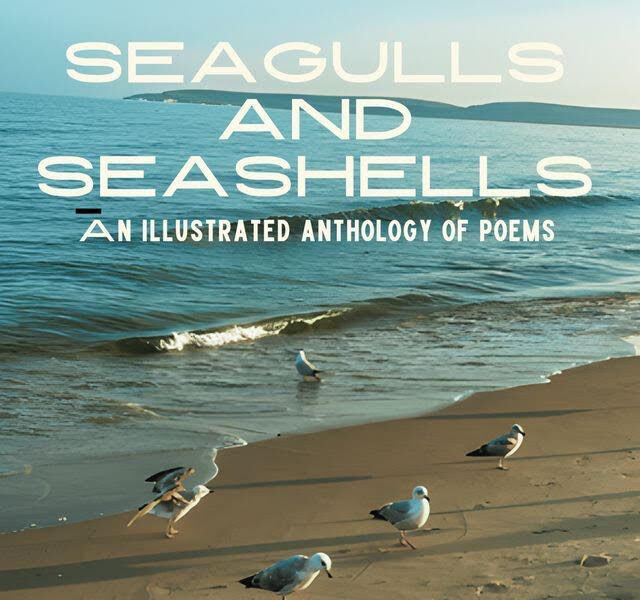
I think one of the most beautiful aspects of ekphrasis is its ability to be timeless. It is a form that uses narrative to expand a scene, a moment, or a work of art in a way that preserves perspective, and allows us to return and re-witness regardless of age or era. It captures moments with both the mind and the physical eye and renders them into words. It is a literary technique that grounds the reader in a still and moving idea of place, and Tobi Aluko masters this technique in his poetry collection Seagulls and Seashells. He describes the beauty of nature and the human condition in tender, attentive ways. The romanticism and imagery woven through its pages reminds us that the art of yearning is not lost, that desire can still be witnessed, observed, and documented in both mundane and deeply special ways.
Take the opening poem, “Roses for Qu.” Where a lover is a metaphor for a rose, and the persona in the poem is exploring what it means to offer love and test for mutual desire. Lines such as “I walk into my garden / to look for the rosebud I have watched for days; / its petals have sprouted,” and “I lead you to my garden and show you flowers, / and search for the excitement in your eyes.” illustrate this clearly. Or in “Summer Days,” where the lines, “Does the sweetness of the sea salt / find its place on your lips? / Our clothes flip-flap in response to the wind. / Can you hear the seagulls call one another as they land on the shore?” shows us that truly this collection is a sentimental lineup for anyone who cares deeply about the art of loving.
“Poetry Club” is one of my favourite poems in this book because it articulates both the blessing and curse of being a poet today. It opens: “In the poetry club, / we listen to each other, / and nitpick each other’s poems. / We try to guess who was written by AI. / Who is real? / Who is with the machines?” Almost every poet can relate to that.
Many of the poems in Seagulls and Seashells were written in Bournemouth, and the collection uses this coastal setting as a stage on which questions of belonging, history, and connection can be unpacked. “Stargazing” takes us to a pier haunted by ancestors who once walked there in shackles. Here the local is a portal into the universal, contrasting past enslavement with present freedoms and bridging generations through cosmic visions of pain and hope.
Aluko’s use of sensory details as a descriptive tool is exquisite. He is particular about the particulars and details of people, places and things. In this poem you can smell the lavender, enter the doorways, hold space for the homeless sleepers, among other things. The author is calling people back to attention amidst the noise of the 21st century. This is the work of a visual, observational artist whose poems seem caught in the wild and later refined in a way that feels like home.
Aluko, a Nigerian, understands the emblems of a new life lived in a liminal space between continents and he deftly documents it in portraits and poems. It is so masterful to see how the paintings and poems inform one another. In “An Evening at the Park,” the persona observes a beautiful woman wearing a scarf with “the colours of winter” and a dress bearing “the patterns of autumn…” The missed opportunity arrives when he realises she has a lover. I wonder what direction the poem might have taken if nobody had kissed the beautiful woman, if the persona had gotten a chance to talk to her. A similar wonder appears in “Chasing Pigeons,” where a pigeon takes flight and lands just out of reach. Both poems are a moving metaphor for how we chase affection, only to be bruised by it.
The collection’s central contemplation, I think, is expressed in the poem “Awe,” “does your mind path to embrace the awe? / of what could be / of what you want to be / of what I want to be / of what we want to be.” These lines attempt to summate the crux of this illustrated anthology of poems. It makes you wonder, contemplate and ask existential questions about nature, and consider the lives and places within it.
In “Love or Beale Street,” the ending lines read, “I felt my love might be too intense to speak of, so I spoke to her about Beale Street instead.” It is so moving to me, this idea that to understand love, we must attempt to anchor the feeling, however blue, to a specific place, to reveal the nuances and crux of what we cannot experience.
In “Lavender Fields,” love and commitment appear through colour and scent, “purple, like the crown / on a mother’s head,” lavender filling a car as newlyweds drive away from the church. These are visual metaphors, the work of someone composing in colour and texture as much as in words and sound. Tobi Aluko makes the reader stop and stare as they flip through the pages. The collection is not merely a scrapbook of pretty pictures. It is deeply concerned with modern life—in capitalist economies, in social media-saturated cultures, in conflict, amid shortened attention spans and anxiety. It asks about how we spend our days. Are we conscious? Are we not? Are we in a simulation?
In “The Butt,” a man picks a stamped-out cigarette from the pavement, draws in “the last drag of flavour,” and “for a second, / he forgets / he is homeless.” In “Sound Sleep,” a homeless speaker says, “I am safest in my sleep,” even as cars roar and passersby drop coins into a “little cup” that funds his cigarettes. Aluko processes emotions on the page and what it teaches us is to confront things he does not fully understand.
In poems like “21st Century Romanticism,” “Put the Phone Down,” and “They Sell Weird Things at the Mall,” the poet is asking about our realities and what we will make of it. “21st Century Romanticism” builds a rapid-fire catalogue of questions: “Why are we glued to our phones? / Who will save us? / Why does she have to swipe right through / avatars to get a date?” The interrogative form mirrors the current restlessness permeating the world as we adjust to new realities.
“Put the Phone Down” is more intimate but equally political. Aluko has spoken about how, in his Nigerian childhood, children played outside until evening, whereas now fear, screens, and changing norms keep them indoors. This ache animates the poem’s plea: “Can we play outside today? / The sun is shining, and inside is cold.” The direct questions and repetition (“Can we… Can we… Can we…”) throughout the poem give the tone of a child, or the childlike part of an adult, begging for community, for a communal or shared presence.
When you pick up this book you will also notice Aluko’s precision in arranging the poems. The poems are arranged in a carefully woven thread, where one leads naturally into another, sometimes through emotion, a repeated word or an image. The collection reads almost like an album, each poem placed deliberately like a track in a playlist you make for a lover when you want them to see you and see the world through your eyes.
Some poems in the collection do a great job of examining history and spirituality, particularly Black history. “God Is in the Water” recalls the transatlantic slave trade and the Igbo Landing narrative, where enslaved Igbo people chose death in the water over a lifetime of bondage. This history is braided with theology: “I searched for God in the pews, / but God is in the water.” God appears not only in the beloved’s terracotta skin and cornrows but also “on a ship in May 1803, / shackled at the feet,” and in the choice to step into the water rather than toil in “spinning mills and checked clothes.” Metaphor, history, and scripture intertwine as Aluko riffs on the Johannine idea of all things created through the divine Word. The result is a poem that relocates holiness from respectable spaces to the bodies and choices of the oppressed.
The book advocates for slow living in this fast paced world and this is a radical request in and of itself. Seagulls and Seashells does not shout its politics or experiment flamboyantly with form. Instead, it invites us to look closely at a rose, a pigeon, a lavender plant, a phone screen, a homeless sleeper, a lover or a line of ancestors walking a pier in chains. In an era of relentless noise, that invitation may be its most subversive gesture. Aluko’s Seagulls and Seashells is not prescriptive or necessarily instructive but it will teach you how to see, it will teach you to love people. The poet is a visual artist whose art keeps attempting to reflect the times in words and images. You will feel like you are staring at art pieces in a museum or gallery as you read this collection.
Crédito: Link de origem
Comments are closed.