

African Union Agenda 2063 and the Conflicts Threatening “The Africa We Want”
When the African Union announced Agenda 2063 in 2015, it was touted as Africa’s most ambitious road map yet. It pledged a prosperous, democratic and peaceful continent, under the guiding spirit of “The Africa We Want,” as part of the Pan-African vision.
The vision was bold. The continent would, by 2063, be linked together by high speed rail, trade freely with each other as a single market, and power Africa’s cities from renewable energy from mega-projects such as the Grand Inga Dam. But a decade later this dream is facing its sternest test, war.
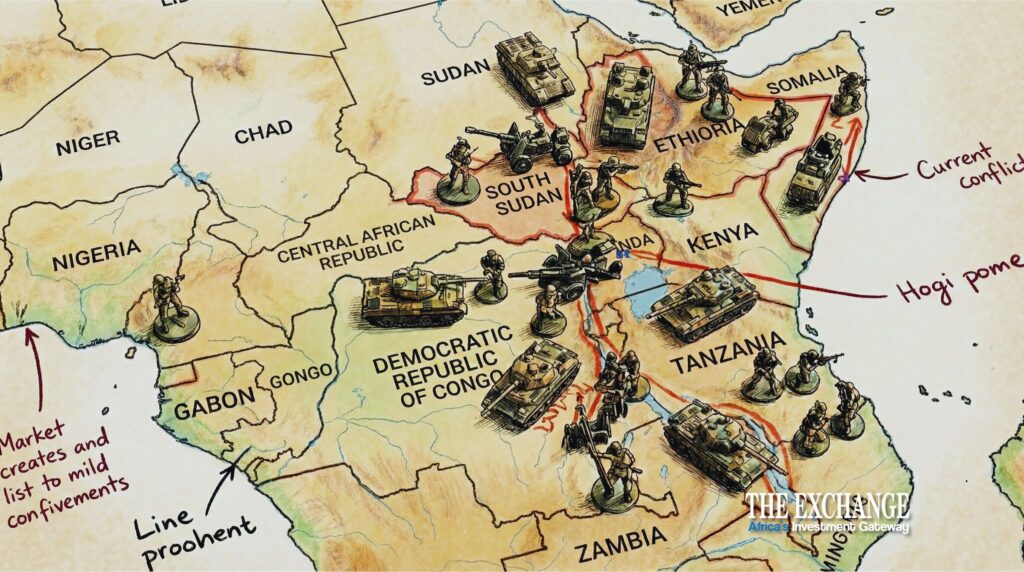
From Sudan’s civil war to the persistent instability in the Democratic Republic of Congo and from tensions between Ethiopia and Eritrea to continuing violence in Somalia, conflict has turned Africa’s collective commitment to staying on track into a test.
(Source: Africa Center for Strategic Studies)
What Is the African Union Agenda 2063
Origins and Goals
Agenda 2063 is not a programme for now; rather, it is a fifty-year plan. As Amb. Frederic Gateretse-Ngoga, Senior Adviser on International Partnerships and AU Border Program outlined in an interview with the Africa Center for Strategic Studies,
“Every regional community needs a long-term plan, and clear vision for the future that we want to continue aiming for,” he said, “and some way to monitor progress toward the vision.”
The blueprint sees Africa as united, prosperous and at peace with itself. It aims to eliminate poverty, enhance governance and infrastructure, and embed development in common values of democracy, human rights and cultural identity.
Seven Aspirations of Agenda 2063
It is driven by seven aspirations:
- A strong Africa based on growth fed by inclusivity and sustainable development.
- One continent, one people, one destiny on a Pan-African basis.
- A continent characterised by good governance, democracy and rule of law.
- An Africa which is at peace with itself.
- Cultural identity and a shared history.
- A people-oriented development model through the empowerment of women and youth.
- An influential Africa, which is a peer in the world.
Flagship Projects Driving the African Union Agenda 2063 Vision
To ensure that the lofty ambitions are translated into concrete achievements, Agenda 2063 came up with fifteen flagship projects. They include:
- The African Continental Free Trade Area (AfCFTA), the largest free-trade zone in world history, projected to increase intra-African trade by over 50 percent.
- The Single African Air Transport Market (SAATM) for opening up skies and lowering the cost of travel.
- The African Passport and Free Movement Plan to ease visa requirements for Africans.
- The 12,000-kilometer Integrated High-Speed Rail Network.
- The Grand Inga Hydropower Project, in the DRC, one of the world’s largest renewable-energy developments.
- Pan-African Digital and Education Platforms like the Pan-African Virtual and E-University (PAVEU).
These endeavors are unified for the purpose of bridging, educating and empowering Africans within a single economic and cultural union.
Tracking Progress and Implementation Gaps
In the first decade of Agenda 2063, around 50 percent of its targets were achieved. The AfCFTA went into effect, energy integration grew and visa reforms in the likes of Ghana and Rwanda made for easier travel.
Yet major obstacles remain. Funds remain limited, data to track progress is inconsistent, and many projects have been slowed by political volatility.
As Amb. Frederic Gateretse-Ngoga acknowledged,
“Financing gaps remain, and implementation is uneven. Agenda 2063 has been domesticated into national development plans by some countries, while others find themselves struggling because of a lack of institutional capacity. Security threats in the Sahel, Horn of Africa and portions of Central Africa persistently destabilize progress.”
Why the African Union Agenda 2063 Still Matters
All the same, Agenda 2063 is still the most plausible framework for reconstruction across the continent. It restores Africa’s agency after decades of donor-led development, putting the continent on a path to become a global powerhouse based on its own priorities.
Africa will be home to more than 2.5 billion people by 2050, sixty percent of whom will be under the age of 25. Developing that youthful potential is essential for innovation and industrialization. Agenda 2063 provides a blueprint for that through education, technology and regional integration.
The Exchange Africa in Conversation with Amb. Frederic Gateretse-Ngoga
Amb. Frederic Gateretse-Ngoga took The Exchange Africa through how conflict is undermining gains made under Agenda 2063 in a follow-up interview.
Seated in his office at the AU Commission in Addis Ababa, he first connected Africa’s vision for convergence to the lives of its people.
“The 2063 vision will fail if it’s not a people project,” he said. “All Africans should feel the impacts of integration in development through jobs, roads, power and trade. Otherwise, Agenda 2063 will only be in the realm of a policy document rather than lived experiences.”
He stopped for a moment, pointing out how those gains often fail to translate into benefits for citizens. In Sudan, infrastructure projects have been built and then torn apart by war, he said. Rail and road links in the DRC are frequently cut by rebel activity.
“When war breaks the peace of trade corridors or energy projects, that opportunity closes,” he added. “People don’t eat vision, they need peace to see results.”
Asked about regional cooperation, Gateretse pondered why progress has been so uneven.
“Africa does not have a shortage of plans but it has a shortage of implementation discipline,” he said. “The next 10 years have to be about demonstrating and measuring that integration, with operating rail corridors, visa-free travel and access to energy,” she said.
He highlighted the need for political will to be accompanied by institutional stability. Nations undergoing internal conflict face difficulty in sticking to policies and not allowing long-term plans to operate.
His tone grew urgent as the discussion turned to the increasing number of active conflicts on the continent.
“Conflict prevention is development policy. Without peace all that we have built goes down the drain.”
His words reverberated through the halls of the AU headquarters, a warning that the best-laid plans can only exist in an environment where stability is dominant.

Conflict Across Africa and Its Impact on Agenda 2063
The Economic Cost of War
Conflicts reduce annual GDP growth on average by two percentage points and can wipe out decades of development gains, according to the International Monetary Fund. According to estimates by the African Development Bank, insecurity and violence cost African economies more than 170 billion dollars per year in lost trade, destroyed infrastructure and reduced foreign investment.
Sudan’s Civil War
Sudan has been at war with itself since 2023. More than 12 million people have been uprooted, in what is the world’s largest internal displacement crisis. The country’s once-promising economy has shriveled by nearly one-third, the World Bank reports.
Amb. Frederic Gateretse-Ngoga cited Sudan as a cautionary example of what occurs when politics splinters development.
“The human cost is devastating,” he said, “but so is the economic one. With every bomb that falls, we lose a bit of our continental dream.”
The Democratic Republic of the Congo
In a country that is one of the most resource-rich in Africa, abundance has been swallowed by adversity. There has been no possibility to build new rail lines and power grids because of the fighting in the east. Analysts calculate the instability robs the country of more than four billion dollars in lost export revenue each year.
The impacts of these losses ripple beyond the DRC. Countries next door that depend on Congo’s mineral exports or its transit corridors suffer from shortages that slow manufacturing and diminish regional competitiveness under the AfCFTA.
Ethiopia and Eritrea
A tenuous peace between Ethiopia and Eritrea in 2018 had given the impression of a stabilizing Horn of Africa. But repeated violence in northern Ethiopia and across the borderlands has disrupted trade routes and upended confidence. The railway showcased African integration, but it now runs at less than capacity, with security risks playing a part.
“Instability in one country rapidly affects others,” Amb. Frederic Gateretse-Ngoga noted. “You cannot survive war behind barbed wire,” he told The Exchange Africa.
Somalia’s Continuing Struggle
Somalia is mired in a protracted war against Al-Shabaab. And while progress has been made on the reclaiming of territory, instability continues to discourage investment and drain national budgets. Somalia’s recent accession to the East African Community provides an avenue towards integration, but under conditions of a stable security environment.
Tensions Rising in Tanzania and the Region
Even in relatively stable nations, there are warning signs. In Tanzania, intermittent civic tensions and curbs on media have raised questions about whether it needs to be more inclusive. Political analysts caution that ignoring such concerns could erode trust central to collaboration among regional states.
Amb. Frederic Gateretse-Ngoga said political openness is the cornerstone to sustainable development.
“Peace is not merely the absence of war,” he said, “it is the presence of justice, opportunity and participation.”
Why Conflict Undermines the African Union Agenda 2063
Every war siphons money from schools, roads and energy projects to emergency relief and defense. It disrupts trade routes, moves skilled talent away and dilutes investor confidence.
Amb. Frederic Gateretse-Ngoga said that even localized instability disrupts continental plans.
“When one country burns, a choking neighbor is looking for water,” he said. “Integration depends on trust, and conflict undermines that trust.”
Financing Peace and Development in Africa
The African Union has accepted that Agenda 2063 will be a non-starter in the absence of peace. The AU Peace and Security Architecture (APSA) gives priority to early warning, mediation and conflict prevention.
Funding, however, remains limited. The total price tag for achieving Agenda 2063 is in the trillions of dollars. To fill the gap, the AU is investigating blended finance instruments, diaspora bonds and public-private partnerships.
Design targeted reforms and ensure accountability, because there are also countries like Rwanda or Ghana that have been able to draw investment. But as Gateretse said, stability is still the ultimate lure for capital.
“Investors chase peace the way rivers chase gravity,” he said.
Building Ownership Among African Citizens
One of the more silent threats to Agenda 2063 is citizen consciousness. Even as integration features prominently on the agenda at East African leaders’ summits, many Africans at the grassroots are unsure of how the plan touches their lives.
“The vision only becomes a reality when it is translated into tangible benefits such as employment, roads, or travel being made easier,” Amb. Frederic Gateretse-Ngoga said to the Africa Center for Strategic Studies.
Civil society organisations, youth movements and the African diaspora were called to do more. In 2024, cash-backs sent home from the diaspora topped one hundred billion dollars, more than all aid to the continent. Putting those resources into projects of Agenda 2063 could help plug funding gaps and deepen ownership.
The Road Ahead for Agenda 2063
The Decade of Acceleration (2024–2033) is what matters. Regional rail links, more access to electricity and liberalized air travel are among the AU’s goals. By the 2040s, industrial transformation and value-addition through manufacturing and technology will be new focal points.
But none of that will happen without peace. As Amb. Frederic Gateretse-Ngoga stressed, development and security are related.
“Prevention of conflict as a separate policy is not such,” he said. “It is the oxygen of development.”
A Call to Action for Africa’s Future
Agenda 2063 is Africa’s boldest promise to itself, but it will also be its severest test. It requires strong leadership, accountability and above all, peace.
As long as clashes continue in Sudan, the DRC, Ethiopia, Somalia and beyond, the dream of a unified Africa will be deferred. But if countries can hush the guns and commit to cooperation, the continent’s youthful energy can still reshape global growth.
As Amb. Frederic Gateretse-Ngoga stated,
“Agenda 2063 is not just a roadmap, it is a call to action. It takes visionary leadership, institutional resilience and above all the active ownership of our citizens and diaspora.”
Africa has reached a critical juncture, one that spans between vision and volatility. The decision will reveal whether 2063 is the year a dream comes true, or another pledge sacrificed to war.
Crédito: Link de origem
Comments are closed.