

Full specs, price, and value in Nigeria

The Xiaomi Redmi 14C is one of the newest additions to Redmi’s C-series, a lineup made for people who want long battery life, a big screen, and a capable camera without spending too much. The 14C follows that same philosophy. It delivers reliable everyday performance, smooth interaction, and features that offer substantial value for the price.
You get a large 6.88-inch display with a 120 Hz refresh rate, which makes scrolling feel fluid, along with a 50-megapixel primary camera that captures clear photos. Its size and weight reflect its purpose: prioritising more screen space and a bigger battery over a slim or compact build.
Announced on August 30, 2024, the Redmi 14C comes with Android 14 and Xiaomi’s HyperOS, so you’re getting the latest software experience right out of the box.
Redmi 14C price in Nigeria
The Redmi 14C enters the budget category in India at about $100 (₹8,998) for the base model, but the price in Nigeria is higher due to import costs, currency fluctuations, and local taxes. Nigerian retailers price the phone based on RAM and storage, which gives you two clear options.
The 4 GB RAM and 128 GB storage model usually sells between ₦127,600 and ₦129,600. The higher model with 8 GB RAM and 256 GB storage costs about ₦160,600. The difference of about ₦33,000 reflects the additional performance and storage you get when you multitask heavily or store many files.
A large part of the valuation comes from the 5160 mAh battery. For most Nigerians, a long battery life is a basic necessity given the country’s irregular power supply. Retailers highlight this feature strongly because the bigger battery helps you stay connected and productive for longer. It also supports the higher price point since battery strength is one of the main reasons buyers choose this phone.
Redmi 14C estimated pricing in Nigeria (NGN)
Full specifications
The Redmi 14C is built to balance cost and performance. It focuses on strong battery life, a fast display, and hardware that keeps daily use smooth.
1. Design and build
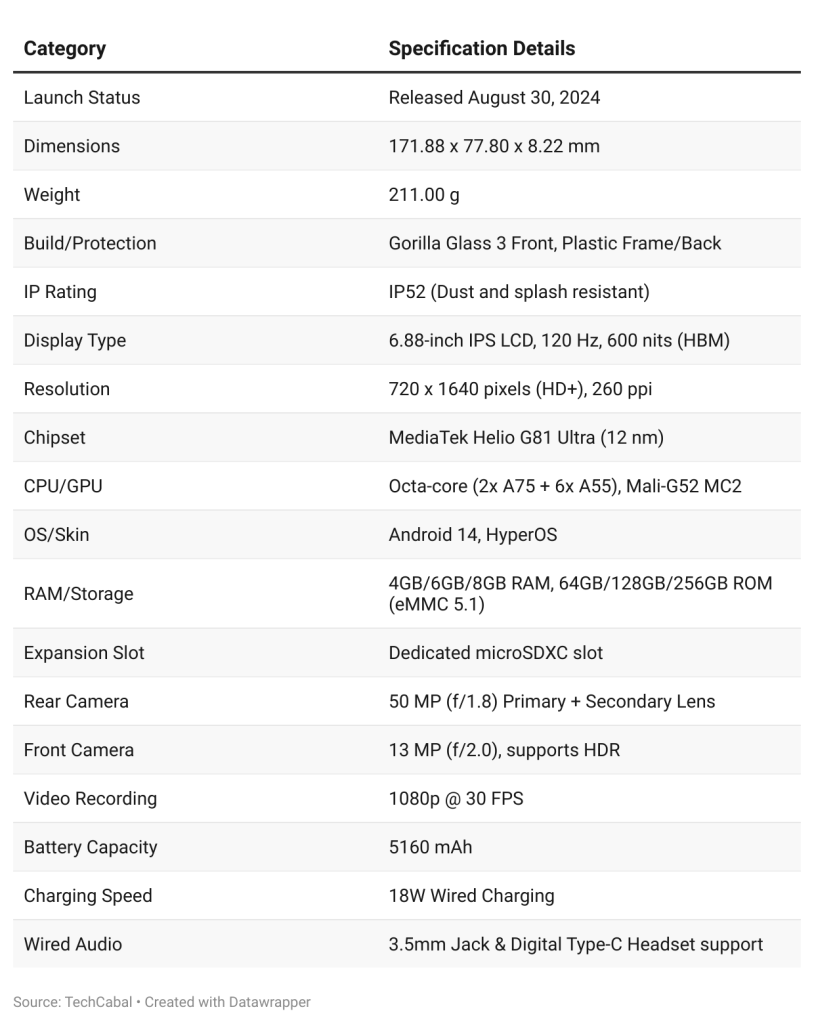
The phone measures 171.88 mm in height, 77.80 mm in width, and 8.22 mm in thickness. It weighs 211 grams. The screen is protected by Corning Gorilla Glass 3. The frame is plastic, and you can choose a glass back or a silicone polymer back. It has an IP52 rating, which gives you basic protection against dust and light splashes. You can get it in Dreamy Purple, Midnight Black, Sage Green, or Starry Blue.
2. Display
You get a 6.88-inch IPS LCD screen with an 84% screen-to-body ratio. The resolution is 720 x 1640, and the pixel density is about 260 ppi. The highlight here is the 120 Hz refresh rate, which makes scrolling and gaming feel smoother. Brightness peaks at 600 nits in High Brightness Mode and sits at 450 nits during everyday use. The mix of a fast refresh rate and HD+ resolution keeps the phone affordable while still feeling responsive.
3. Performance and software
The Redmi 14C runs on the MediaTek Helio G81 Ultra chipset built on a 12 nm process. The processor has two Cortex-A75 cores at 2.0 GHz and six Cortex-A55 cores at 1.8 GHz. The Mali G52 MC2 GPU handles graphics. This setup gives you enough power to enjoy the 120 Hz display without paying higher prices. It ships with Android 14 and Xiaomi HyperOS, and it supports features like the Google Gemini assistant.
4. Memory and storage
You can choose from 4 GB, 6 GB, or 8 GB of RAM, with storage options of 64 GB, 128 GB, or 256 GB. Storage uses eMMC 5.1, which is slower than UFS but common in this price range. If you need more space, the phone supports a dedicated microSDXC card slot.
5. Cameras
The rear system has a 50 megapixel primary camera with an f/1.8 aperture. The secondary sensor supports image processing, although its details are not specified. The front camera is 13 megapixels with an f/2.0 aperture and includes HDR and a soft light ring for low-light selfies—both the front and rear cameras record at 1080p and 30 fps. Camera modes include 50 MP mode, Night mode, Portrait mode, HDR mode, and Time-lapse.
6. Battery and charging
Power comes from a 5160 mAh battery. Charging is capped at 18 W. It is slower than the Note series and newer models that charge at 33 W or more, but its larger battery gives you more extended use between charges.
7. Connectivity and sensors
The phone supports Dual Nano SIM with 4G LTE. You also get Wi Fi, Bluetooth 5.40, and NFC. Ports include USB Type-C and a 3.5 mm headphone jack, with support for Type-C digital headsets. Security options include a side fingerprint sensor that can store up to five fingerprints and Face Unlock.
Redmi 14C complete technical specifications
Comparison with other Redmi phones

From left to right: Redmi 15C, Redmi 13, Redmi 12, Redmi Note 13 4G
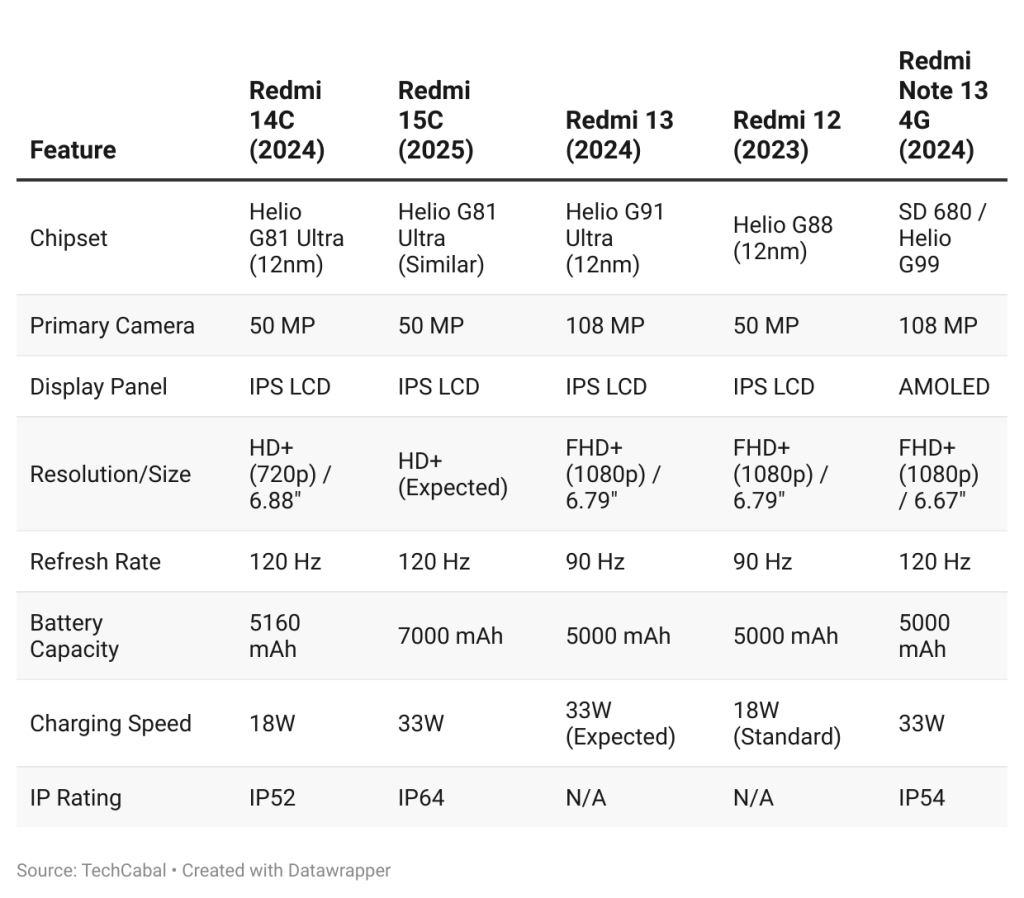
The Redmi 14C sits in the budget tier, so the best way to understand its place is to compare it with other Redmi models that buyers in Nigeria usually consider. The phone focuses on a fast 120 Hz screen and a large battery, but makes trade-offs in charging speed and display resolution.
1. Redmi 15C
The Redmi 15C puts pressure on the 14C because it improves two significant areas. It has a large 7000 mAh battery and faster 33 W charging. It also offers a stronger IP64 rating. These upgrades solve the main limitations of the 14C, which uses a 5160 mAh battery and 18 W charging. The gap shows how quickly power and durability have become key selling points in this price range.
2. Redmi 13
The Redmi 13 is a step up in performance. It uses the Helio G91 Ultra chipset, which is stronger than the G81 Ultra in the 14C. The Redmi 13 also has a 108 MP primary camera. The 14C offers a smoother 120 Hz refresh rate, but the Redmi 13 retains a sharper FHD+ display, which many users still prefer.
3. Redmi 12
The Redmi 12 came with a 6.79-inch FHD+ display and a 90 Hz refresh rate. Xiaomi changed direction with the 14C by raising the refresh rate to 120 Hz, slightly increasing the screen size, but lowering the resolution to HD+. This makes the 14C feel faster to use, even if the picture is less sharp.
4. Redmi Note 13 4G
The Redmi Note 13 4G reminds you what the C-series leaves out. It uses a 120 Hz AMOLED display with FHD+ clarity, has faster 33 W charging, and includes a 108 MP camera. The Note series is built for users who want better screens and stronger cameras, while the 14C focuses on keeping costs low.
5. Redmi 13C
The Redmi 13C is the direct predecessor in the C-series. The 14C improves on it by using the Helio G81 Ultra chipset and moving to a 120 Hz refresh rate. Older C-series models often used slower chipsets and lower refresh rates, so the 14C offers a smoother experience for basic tasks.
Related post: All you need to know about Xiaomi’s Redmi 15
Technical comparison: Redmi 14C vs. Key Redmi alternatives
Frequently asked questions
These questions come from what buyers usually search for when trying to understand how the Redmi 14C holds up over time. Many of them focus on price, durability, software support, and battery strength.
- Is the Redmi 14C worth buying in 2025?
It depends on the price you get. The Redmi 15C offers a 7000 mAh battery and 33 W charging, so the 14C makes more sense if it gets a good discount. If you want a smooth screen and long battery life at a low cost, the 120 Hz display and 5160 mAh battery still give you substantial value.
- How does the Redmi 14C perform after six months?
Performance depends on HyperOS updates and your storage usage level. The Helio G81 Ultra chipset is stable. The eMMC 5.1 storage is slower than UFS, so you may notice slowdowns in multitasking or app loading once the storage becomes packed.
- What colours can I buy?
You can get the 14C in Dreamy Purple, Midnight Black, Sage Green, or Starry Blue.
- Does the Redmi 14C support Google Gemini?
Yes. The phone runs Android 14 with HyperOS, so you can set up and use the Google Gemini assistant without issues.
- What is the IP rating?
The Redmi 14C is rated IP52. It handles small dust particles and light water splashes, but it is not built for deep exposure.
- Is the battery removable, and how fast does it charge?
The phone has a non-removable 5160 mAh battery and supports 18 W wired charging.
- What is the maximum video resolution?
Both the front and rear cameras record at 1080p and 30 fps.
- How do I get software updates?
Updates are delivered over the air through Xiaomi’s HyperOS update system.
- Does the Redmi 14C have a notification LED or touch button light?
No. It does not support touch button lighting. You will rely on the main display for alerts.
Crédito: Link de origem
Comments are closed.