

Tearing up the business plan to build Rwanda’s largest chicken farm
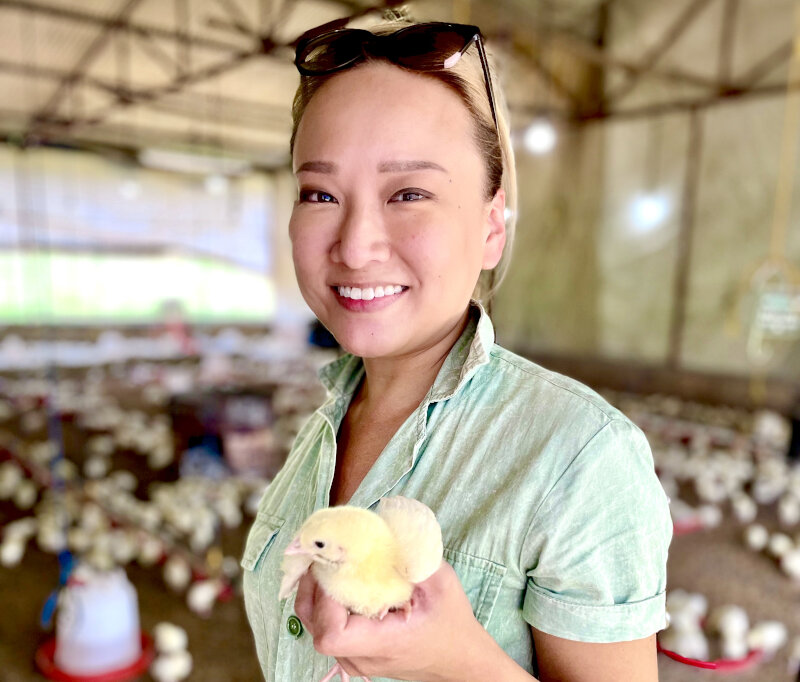
Shumei Lam
Interview with Shumei Lam
FOUNDER and MANAGING DIRECTOR, POULTRY EAST AFRICA LTD
Lives in: Singapore/Rwanda
In most of the world, chicken is one of the more affordable protein options. However, when Singaporean Shumei Lam first visited Rwanda in 2011, it was considered a luxury that most Rwandans could only afford on special occasions. The primary reason was the absence of commercial chicken farms – a market gap that she would eventually step in to fill.
Lam, who had a background in marketing and advertising, travelled to the country on a business trip with her late father, Larry Lam. He had founded the global port operations business Portek International, which at the time held an interest in an inland port in Rwanda.
It was Lam’s first visit to sub-Saharan Africa, and she was surprised by what she found in Rwanda. “It was way more developed than I expected. You could tell that at that point it was kind of on the cusp of becoming something greater. I felt safe there.”
The idea to invest in a poultry venture was first floated to her father by one of his associates, and he encouraged his daughter to pursue the opportunity. For the family, the venture also had a social objective: to provide affordable meat to a country where many people suffered from a lack of protein intake. But for the business to be sustainable, she knew it had to be profitable.
With no prior farming knowledge, Lam sought guidance from experts in Singapore, Malaysia, and the Netherlands, as well as locals in Rwanda. She spent about a year developing the business plan before officially incorporating Poultry East Africa Ltd (PEAL) in 2012.
Once the company was registered, the next step was securing land. Lam identified a site in Bugesera, roughly 45 minutes outside the capital, Kigali. Purchasing the land proved to be a complex process that took about eighteen months. She had to negotiate with twenty-four separate families, each owning approximately one hectare, to cobble together two plots large enough for PEAL’s operations.
Construction of the production facilities took a further six months. With the infrastructure finally in place, PEAL commenced production at the end of 2014. The scale of the facility was unprecedented for the country. “The moment we started operation, we were immediately the largest poultry farm in Rwanda,” Lam says, “and we continue to be to this day.”
***
Although she hired an experienced general manager to run the business, Lam remained hands-on during the startup phase. “On day one of the processing, I was there in the processing plant packing with them until the wee hours of the night,” she recalls.
The next day, she accompanied the driver in the truck to show him how to handle delivery notes and invoices. “This was a completely new industry,” she says. “I had to train everybody from scratch.”
The business faced numerous unexpected challenges at the start. Lam notes that from an infrastructure perspective, the Rwanda of the early 2010s was very different from the country it is today. Water supply was a major hurdle; the company had to truck water to its facilities, which significantly increased operating costs. Reliability of the power grid was another issue, with frequent electricity outages.
The original business model was developed based on a selling price of about US$8 per kilogram of chicken. However, shortly after operations began, the price crashed to less than $3. The issue was oversupply. Many small-scale farmers brought their stock to market simultaneously, driving down the price for everyone. Boom-and-bust supply cycles would become a recurring theme.
Initially, the company focused predominantly on business-to-business sales, targeting hotels, restaurants, and traders who supplied export markets. To build this client base, Lam personally went door-to-door to secure orders. She admits it was sometimes a struggle. “At one point, I remember the five-tonne truck was parked outside my house and it was still filled with two tonnes of product that I hadn’t sold,” she recalls. “I sat outside and said to myself, ‘What have I done?’ We were either going to have to dump all this product or donate it.”
A turning point came when the company identified a new customer base: traders selling meat at local traditional markets. As Lam didn’t speak the local language, she relied on her staff to secure these accounts. Although the margins on these sales were razor-thin, the buyers provided significant volume and paid upfront.
In 2018, the business broke even for the first time.
However, Covid-19 halted that momentum. The pandemic was tough for the business as demand from restaurants, hotels, and the events industry – major sales sources – collapsed. Yet, Lam says the disruption gave the company time to pause and recalibrate.
***
One major change has been a shift in its business model. PEAL began partnering with small-scale farmers, moving away from rearing chickens for meat itself. The company now uses its own farm exclusively to raise parent stock – the breeding birds that produce the fertilised eggs.
The company hatches these eggs at its facilities and supplies the day-old chicks to smallholder farmers, along with feed and vaccines. The farmers raise the birds to maturity. PEAL then buys back the chickens, deducting the cost of the inputs from the final payment.
The company currently works with 430 of these farmers. By operating this way, PEAL has been able to double its production volume.
The business also increased its focus on selling directly to end consumers. It launched a brand called Cooko and began opening its own retail outlets. Currently, there are twelve Cooko shops. Many are situated near traditional markets, catering to traders who buy frozen whole birds in bulk to resell. However, the company also runs premium outlets for high-income city workers, featuring upmarket interiors and offering portioned cuts alongside whole birds.
These retail shops currently contribute about 20% of the company’s revenue. In comparison, corporate customers – such as hotels and airlines – account for roughly 50% of sales. Because these clients typically buy portioned chicken rather than whole birds, the company generates much better margins from this segment.
***
Looking back, Lam says she underestimated just how price-sensitive the market is. A difference of even 10 cents can have an impact on sales. Price volatility also remains an issue, with constant gluts and shortages in the market.
This instability is compounded by the informal sector. It is difficult to compete with these players, who operate without the compliance costs or strict processing regulations that PEAL must adhere to. “They do backyard slaughtering. They put it in a rice bag, put it in their trunk, and take it to town,” she says.
Beyond this uneven playing field, PEAL also has to contend with consumer perceptions. Despite the company’s meticulous food safety standards and cold-chain protocols, many Rwandans still prefer chickens from small-scale producers. “They have this impression that it’s fresh because it’s freshly slaughtered,” Lam explains, even though buyers often have no knowledge of the bird’s origin.
Packaging proved to be another hurdle. With Rwanda’s strict ban on plastic bags, the company is required to use biodegradable clear wrapping for its chicken. However, achieving high-quality printing on this material is difficult. “It’s a struggle to get a professionally branded product,” she notes.
Despite these operational headaches, Lam emphasises that the country itself has changed significantly since her arrival. For her, the transformation is most visible in the dining scene. Back then, Kigali had few restaurants. Today, the capital boasts cuisines ranging from Korean and Chinese to Ethiopian and Greek. “You can literally find anything,” she says. This variety serves as evidence of a greater diversity of nationalities living in the country as well as increased spending power. Additionally, she points out that the nation’s infrastructure has improved drastically.
Lam says the company has recently achieved consistent profitability and is in a strong financial position. While the breeder houses are running at full capacity, the hatchery and processing plant are currently operating at approximately half their potential output. However, there is room to grow; the business owns more land where it can build and there are plenty of contract farmers it could add. But with several new commercial producers entering the market since PEAL started, Lam is monitoring conditions before developing the additional land. For now, a key focus is to continue building the Cooko brand so that the name becomes synonymous with chicken in Rwanda.
Taking stock of the last decade, Lam concedes that the reality was far different from her projections. She might as well have thrown away her original business plan on the first day.
The Singaporean entrepreneur has also reconsidered the management concepts she learnt in business school. She would now opt for managers with experience operating in Africa, rather than those who are just good at number-crunching.
Ultimately, she advises that prospective businesspeople in Rwanda should have a long-term mindset. “It is not a quick money kind of situation,” she says. “It is really about patient capital.”
This article is an excerpt from our latest book How we made it in Africa II. Purchase the book from the official website or from Amazon.
Related articles
Crédito: Link de origem
Comments are closed.